My name is Bronte, I have an undergraduate degree in Criminology with Psychology and I am currently completing my Master’s degree in Forensic Science at UWE. When I first saw the opportunity to become a Student Project Developer, I was immediately interested. I wanted to develop my research and communication skills, gain experience working on a research project with a team, and contribute something meaningful to the UWE community. Looking back over the past year, becoming a Student Project Developer has been such a rewarding and enlightening experience, particularly because of the relevance of the project itself.
Studiosity project
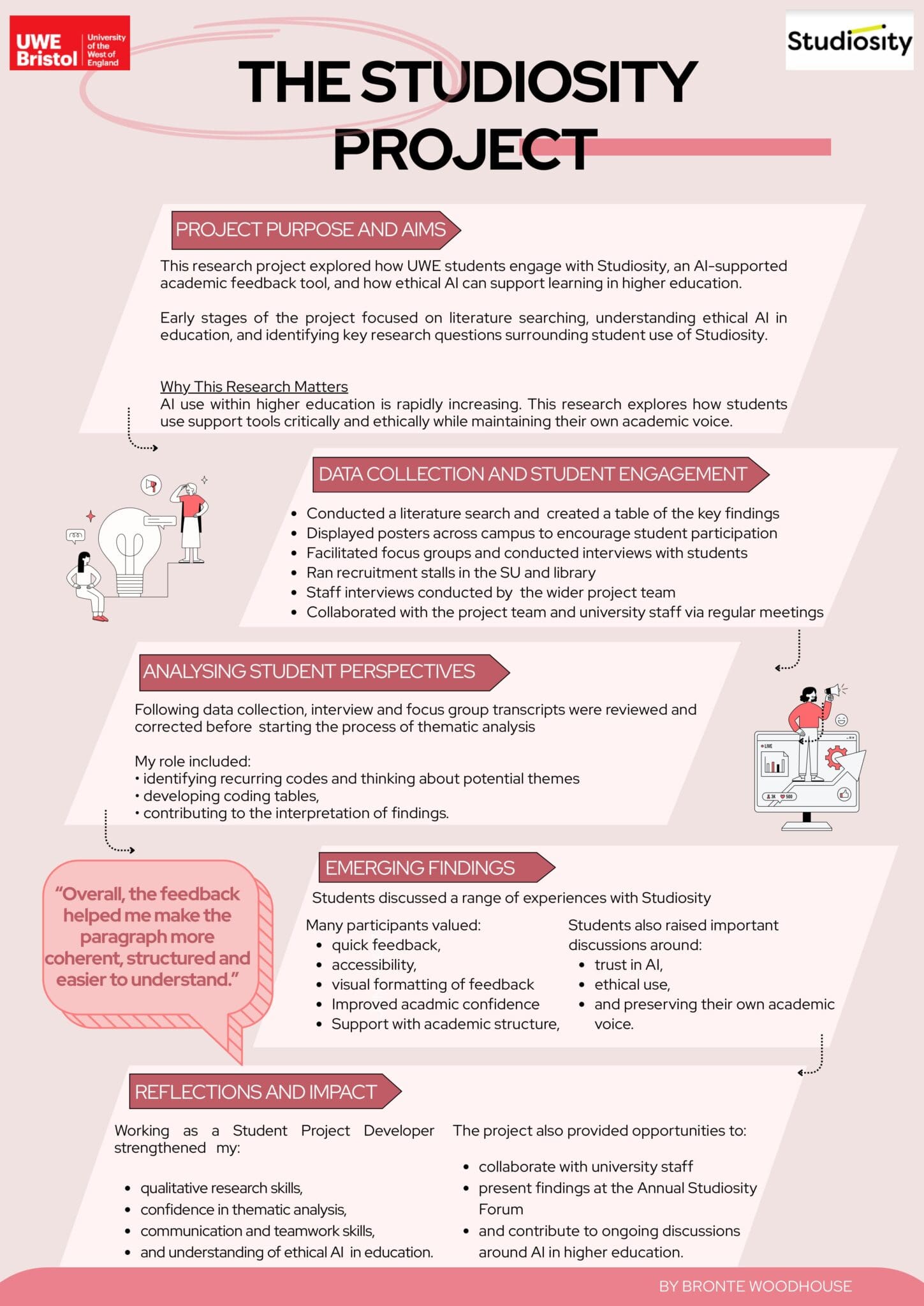
The project I have been involved in explored how students engage with AI-supported learning tools within higher education, using Studiosity as the focus of the research. Studiosity was a platform previously available to UWE students that provided AI-assisted feedback on academic work. Unlike generative AI tools such as ChatGPT or Claude, it did not complete work for students. Instead, it provided feedback on areas such as structure, grammar, spelling, and academic writing, helping students improve their work whilst maintaining their own academic voice. This distinction is especially important in academic settings where maintaining originality and integrity is essential. The project felt particularly relevant given the rapid growth of artificial intelligence in education. AI is becoming increasingly integrated into everyday life and is unlikely to disappear any time soon. While there are understandable concerns surrounding AI, there are also exciting opportunities, and this project highlighted how AI can be used ethically to support learning rather than replace it.
As someone with a background in psychology, I have always been interested in understanding people’s motivations, behaviours, and experiences. The question of why students choose to use particular digital tools, what benefits they perceive, and what concerns they may have is fascinating to me. More broadly, I am interested in the impact AI may have on learning and development. It is a topic that generates a great deal of debate, making research in this area extremely important, particularly within higher education.
Research approach
Throughout the project, I have contributed to exploring the initial research questions in a number of ways. I have attended meetings with the research team, library staff and SU representatives, which allowed me to contribute ideas and better understand how the project has developed over time. I have also taken part in focus groups, where engaging directly with students helped us gain a deeper understanding of their experiences and attitudes towards AI-supported learning tools. Alongside this, I contributed to the analysis process by editing transcripts, creating coding tables, and undertaking thematic analysis of focus group and interview data. This allowed us to identify patterns in how students engage with AI-supported learning tools and how they perceive their role in supporting academic work.
The findings of the project revealed many interesting perspectives on AI-assisted learning tools. Through students’ experiences of Studiosity, many participants spoke positively about receiving quick feedback, the clear, colour-coded format, and support with improving the structure of their work. Students also described how this type of AI-assisted feedback helped build their confidence before submitting assignments and appreciated being able to access support outside of normal university hours. Participants also raised important concerns around trust in AI and maintaining their own academic voice. Listening to these different perspectives reinforced the importance of understanding students’ experiences as AI continues to become part of higher education and learning more broadly.
My reflections
Over the past year, I have thought about how I would want AI-supported feedback to assist me in my own studies. One thing I would particularly value is an AI tool that offers feedback on different assessment types and writing styles. During my Master’s degree in Forensic Science, I had to learn how to write concise forensic notes, reports, and documentation, which was very different from the longer, more interpretative and analytical essays I was used to writing for my Criminology with Psychology degree. I believe I would have benefitted from an AI tool that could provide feedback across a variety of assessment types and writing styles. I also believe AI tools should not make changes for you, but rather assist in identifying areas that may need improvement while allowing you to make the changes yourself, as this can help develop critical thinking skills and the ability to notice one’s own mistakes over time. I believe these tools can function almost like an additional pair of eyes, helping to build confidence and reassure students without taking away their ownership of the work. Finally, as a visual learner, I would appreciate feedback that is presented in a clear and engaging way, making it easy to understand and implement. Many of the features I have described were also reflected in students’ experiences of AI-supported feedback tools explored within this project, and I am interested to see how AI tools will develop and continue to support students completing a range of assessments across different disciplines.
Over the course of this project, I have come to appreciate the value of qualitative research more and more. While quantitative research can tell us what is happening to a degree, qualitative research helps us understand why. By listening to students describe their own experiences, concerns and motivations, we were able to gain a much greater understanding of how they engage with AI-supported learning tools. I think this is especially important to grasp when exploring such a widely debated topic where people’s opinions, experiences and expectations vary so widely. This project has shown me how valuable qualitative research can be in giving people a voice and helping shape future developments in higher education.
Next steps
Although this project focused on one AI-supported learning tool, wider conversations around AI in education are still extremely relevant. As artificial intelligence continues to evolve, understanding students’ experiences and concerns will be essential in ensuring that AI tools are implemented responsibly, ethically and in ways that will enhance learning. I feel very grateful to have been involved in research that helps contribute to conversations that may impact how the university will continue to support students as AI is becoming increasingly integrated into higher education.