

Dr Katrin Hirsch has been a senior lecturer in Optometry at CHSS/SHSW since 2019. She has designed modules since her arrival at UWE and is a member of the AI community of practice.
This case study explores how Katrin learned to accept AI in assessment and redesigned her exams for integrity and inclusion.
The problem
The problem relates to two modules I teach on:
- Investigative Skills (UZYYHL-30-1) – where students learn about visual fields, slit lamp, colour vision, contrast, and patient assessment.
- Dispensing and Optical Appliances (UZYYHJ-15-1) – which focuses on optical calculations and foundational knowledge such as measuring and verifying the powers of spectacles and fitting spectacles.
Each module includes Practical Exams as well as a written exam task, which is made up of 70% Multiple Choice Questions (MCQs) and 30% Short Answer Questions (SAQs).
I moved these exams onto Blackboard to reduce the team’s marking load and to make the assessments more inclusive, especially for students who rely on screen readers. However, I soon realised that students could use GenAI tools like Copilot to answer questions. This raised serious concerns about the integrity of the assessments as GenAI could accurately answer standard MCQs and generate plausible SAQ responses that were good enough to pass.
The solution
After considering approaches like trying to lock down the exams or restrict access to AI tools, I decided to redesign the assessments to make them more meaningful and resistant to AI-generated answers.

I replaced standard MCQs with jumbled sentence questions, using dropdown distractors in Blackboard Ultra. This made it harder for GenAI to guess the correct answers. I rewrote SAQs to include technical case scenarios that required students to use specific terminology and apply their knowledge – something GenAI still struggles with. I created mock exams using these new formats to help students prepare and to test their effectiveness.
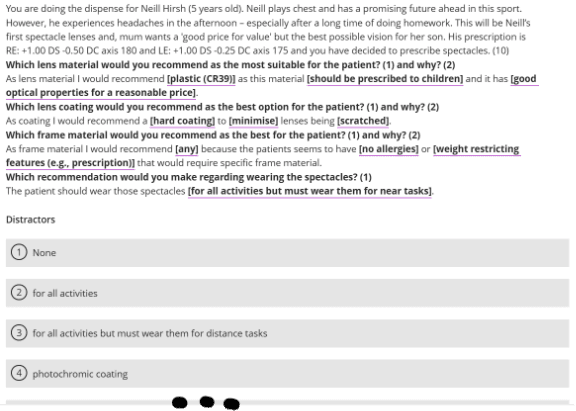
I also began to accept GenAI as a tool. I use it myself to refine my writing, and I encourage students to use it appropriately and critically. I’ve started designing tasks where students use GenAI to solve optical problems, then we discuss the results together. This helps them see both, the strengths and the limitations of AI.
Challenges
Probably the biggest challenge is anticipating how GenAI might evolve. It’s likely that in the future it will be able to handle even more technical content. We don’t know the direction it will take, but it is here to stay.
I also had a moment of doubt when I tested one of my own exam questions in Gen AI and got a completely different answer. I panicked, thinking I had taught something incorrectly. But after consulting an expert I realised that the AI had misunderstood a key principle. That experience reminded me how important it is to critically evaluate AI outputs, a lesson I now pass on to my students.
Feedback from staff and students
I haven’t formally collected feedback yet, but I’ve had no complaints about the exam content. What I have noticed is that students who engaged with the mock exams were more confident and better prepared.
Next steps
Looking ahead, I plan to be more transparent with students about how they can use GenAI in assessments. I also want to continue integrating GenAI into teaching, especially for designing tasks where students solve optical problems (e.g. calculating prismatic effects). I feel I need to emphasise contextual learning and human reasoning, areas where AI still falls short, and help students develop the skills to critically evaluate AI-generated content.
Top 5 tips
- For Short-Answer Questions (SAQs): Ask for technical terms to ensure depth of knowledge and understanding.
- For Multiple-Choice Questions (MCQs): Use ‘jumbled sentence’ type questions with distractors to prevent generative AI from easily providing correct answers.
- Case scenarios: Provide case scenarios for students to derive answers, which encourages critical thinking and application of knowledge.
- Technical terminology: Require the use of appropriate technical terminology to challenge the depth of AI’s understanding.
- Marking: Make sure that total of MCQ marks are below or just reaching the pass-mark.