The week before last Clay Johnson (CBL Digital Learning Manager), James Hazzard (Director of Learning and Teaching and Deputy Head of Department: Education and Childhood), Richard Manley (Strategic Business partner) and I took ourselves along to the annual Higher Education Partnership South Event (HEPN) in Heathrow. The event “brings together the most inspirational leaders and transformational suppliers in the Higher Education sector to share cutting-edge insight, knowledge and experience.” HEPN is an interesting concept in that it shifts all costs directly to the sponsor, making for a free event for the attendees. This does mean quite a lot of commercial sponsorship and hard sell, but some great food and networking opportunities.

The event has a broad audience of senior professionals in high education with themes to match:
Data and University finance
The opening panel session explored data in universities. Richard Michel (Chief Information and Digital Officer, University of London) chaired the discussion between Adnan Akbar (The Open University) and Maneesh Kumar (Technology Systems and Data, Cardiff University). They discussed how staff might to identify at-risk students and measure student satisfaction. With limited resource the conversation was very much about how we progress our data journey – and accepting that there that we must move forward with low quality data. One of the sponsors Lee Rawlinson (Director, Homes for Students) shared more data insights on student housing. Improving the student accommodation experience is crucial for retention, yet it is often treated as an afterthought.
The closing keynote of the event was delivered by Professor Ebrahim Adia (Vice Chancellor of the University of Wolverhampton) who provided a comprehensive analysis of the financial state of UK higher education. He explored the evolving policy context, contrasting the old government’s stagnation on fees and restrictive policies on international students with the new government’s somewhat more supportive stance, albeit countered by rising employer NI costs. The recent sobering assessment from the Office for Students (OfS) highlighted widespread financial instability in the sector, with 72% of institutions potentially running deficits by 2025/26 and 40% facing critical liquidity challenges. There were few quick wins and Ebrahim underscored the paradox of in-year financial crises curtailing the very investments needed for sustainable transformation. A tough year ahead for many of us.
Employability and Podcasting (by Clay Johnson)

Podcasting is fast becoming a powerful vehicle for student engagement and creative expression. More than that, it aligns with a growing trend of multi-modal assessment practices by offering an innovative way to develop and showcase essential skills in communication, critical thinking, and creativity. In her talk, Catherine Chambers explored how podcasting is not only a creative outlet for her students but also a powerful tool for developing essential skills that can significantly enhance their employability in today’s competitive job market. Catherine highlighted that podcasting provides students with the opportunity to hone several key skills:
Communication, for example, which is an essential skill for any student to master. The process of creating a podcast requires students to develop clear, engaging narratives, which directly improves both their verbal and written communication abilities. Similarly, podcasting fosters creativity, as students are tasked with producing unique content that requires innovative thinking and problem-solving. This creative aspect is especially valuable for students pursuing careers in the arts, media, or any field that requires a fresh perspective. Additionally, the act of researching, analysing, and presenting information in a podcast format, she argues, strengthens critical thinking and analytical skills – both of which are highly sought after by employers in a wide range of industries.
Catherine shared valuable strategies for students to create podcasts that capture attention and maintain audience engagement. She emphasised the importance of understanding the audience and tailoring content to meet their interests and expectations. Crafting compelling stories was another key point she raised, as a well-structured narrative is essential for keeping listeners engaged. In addition to content, Catherine stressed the importance of mastering technical skills such as audio editing and production. These technical aspects are crucial to producing high-quality, professional-sounding podcasts that reflect the standards expected in the industry. As part of her delivery at Keele, she encourages students to promote their podcasts through social media and professional networks. This helps them reach a wider audience while helping them gain visibility in their respective fields.
Regardless of the training and support implications, podcasting has the potential to empower both staff and student voices. Furthermore, it offers students the opportunity to build a network of industry professionals by engaging with guests, listeners, and other creators. These interactions can lead to valuable connections that enhance career prospects. Whichever way you look at it—it remains an impactful learning tool with the ability to equip students with essential skills that can enhance their employability or advance their careers.
Generative AI
AI continues to be the buzzword of the day and no conference these days is complete without multiple sessions exploring its use. Anna Artemyeva (Google Education) showcased tools like Google Gemini and Notebook LM, which promise exciting advancements like turning notes into podcasts. During coffee breaks I heard from other attendees about tools like KeithAI and Auth Plus, which automatically generates tailored questions to check understanding as soon as a student submits an assessment.
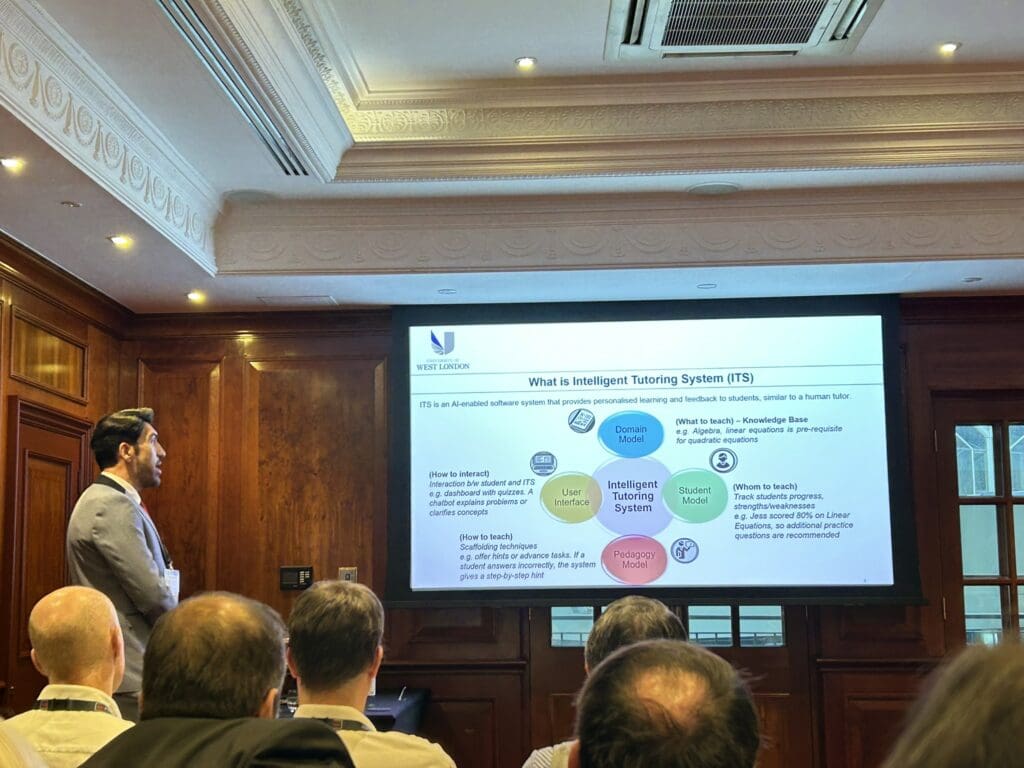
Doctor Ikram Ur Rehman (Associate Professor in Computer Science at the University of West London) presented on leveraging technology to personalise the student experience. He explored strategies for using data analytics, AI-powered tools, and adaptive learning platforms. Ikram began by giving a helpful breakdown of Intelligent Tutoring Systems (ITS): an AI-enabled software that provides personalised learning and feedback, similar to a human tutor. Ikram explained how these systems integrate the domain model (what to teach), the student model (who to teach), and the pedagogic model (how to teach).
I thoroughly enjoyed the presentation by Michael Conlon (XMA Education Transformation Consultant), which tackled our relationship with AI and the broader concerns it raises – academic integrity, the risk of dehumanisation in education, and issues of intellectual property and originality. The presenter offered a thoughtful reassurance: “There are no shortcuts to hard-won knowledge, but there are shortcuts to hard work.” This echoed a growing consensus that soft skills are becoming even more critical as AI evolves. Something picked up in the Building and Developing our Workforces Panel, on day two.
The How have we been using AI in our learning environment? panel, featuring Richard Michel (University of London), Professor Gunter Saunders (University of Westminster), and Adrian Ellison (University of West London) explored AI’s transformative role in higher education. Adrian Ellison opened with a provocative question: “What’s the point of having an AI policy if you don’t know if it’s working?” The panel highlighted the need for staff training, responsible use of generative AI, ethical energy solutions, and a holistic approach to leveraging universities’ research capabilities.
Immersive learning and VR
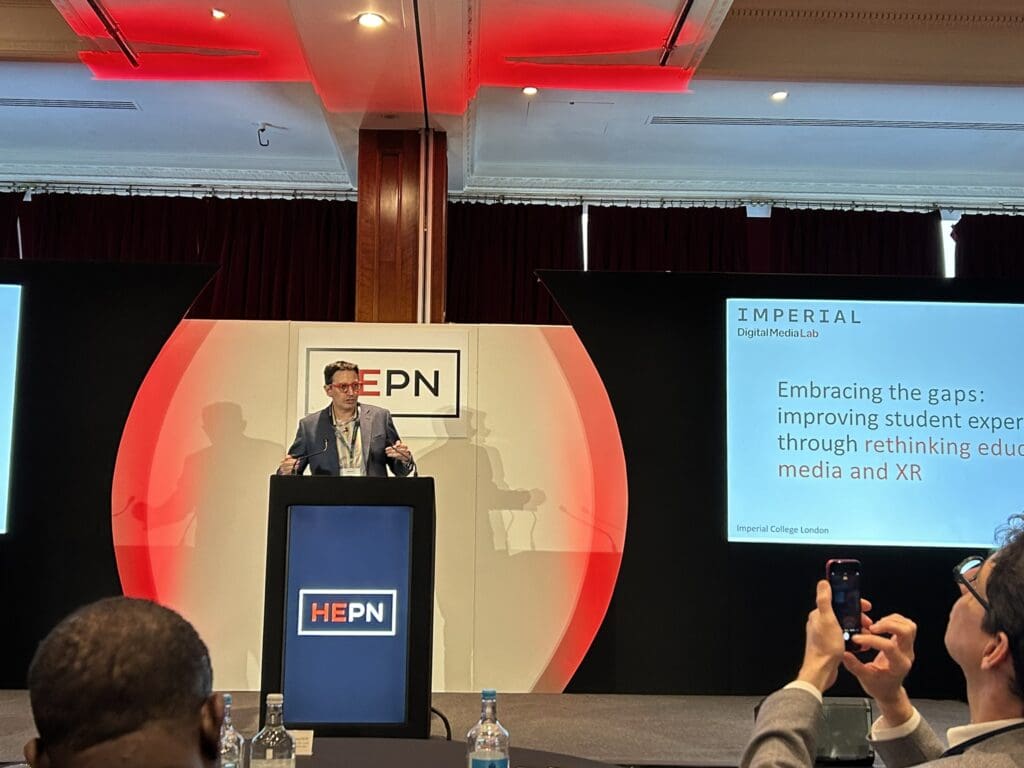
One of my favourite sessions was presented by Daniel Mitelpunkt (Director of Digital Media Lab, Imperial College London) on the opportunities immersive and VR can offer. Daniel began by outlining some of the problems we currently face around technology solutionism, technology evangelism and the rhetoric that platforms offer a panacea. However, at Imperial they have found VR to be transformational in areas like digital twins and medical scenarios, but not always scalable. Daniel galloped through a series of examples from their Project Synchronous Interactive Media (SIM) where they have managed to deliver scaled interactive 3D into teaching spaces, to approaches where they have used ‘praxis synergies’ – members of the team becoming generalists and upskilling in areas.
Learning and Teaching
The closing keynote on day one was presented by Jade Matos Carew (Head of Digital Accessibility and Usability at The Open University). Jade gave a fabulous talk about the importance of digital accessibility in creating an inclusive and equitable learning environment. She aligned it to her struggles in swimming the English Channel.
The following morning Professor Ale Armellini (Dean of Digital and Distributed Learning at the University of Portsmouth) shared insights on improving teaching through innovative approaches. He highlighted Explore, a tool designed to support consistent, high-quality teaching, and ENABLE, the university’s framework for team-based learning design. They have used techniques like storyboarding and a pilot project for creative assessments to push boundaries beyond traditional regulations. Throughout his presentation Ale emphasised importance of focusing on effective teaching rather than making digital tools the ultimate goal.
There was lots to explore at the conference but by far the best aspect lay in the networking opportunities. The lunches and dinner reception were excellent. The corporate meetings with technology companies were a little intense, but everybody made the best of them. It was great to get out of the office and take a wide look at where we are as a sector. Though challenges remain we continue to focus on collaboration and refining and improving digital solutions.