
In parts 1 (why feedback engagement is a design problem) and 2 (designing for uptake) of this series, we explored why student engagement with feedback is best understood as a design challenge, and shared practical ways to support uptake without adding unsustainable workload.
This third article turns to a real programme context, where an academic (Hazel Cottle, Lecturing Occupational Therapist) is actively investigating and trialing changes to feedback practice, not as a one-off intervention, but as part of a scholarly, evidence-informed inquiry. Note that this is a case study in progress.
What was the problem?

I started this work because I became aware that students were being given feedback but not necessarily engaging with it or synthesising it in ways that supported a growth mindset or would positively affect their future learning. There was plenty of anecdotal evidence within the team that certain mistakes were being commonly repeated, module to module, and that students were bypassing opportunities to celebrate good skills they had demonstrated because a lower ‘grade’ than they hoped for was eclipsing the detail.
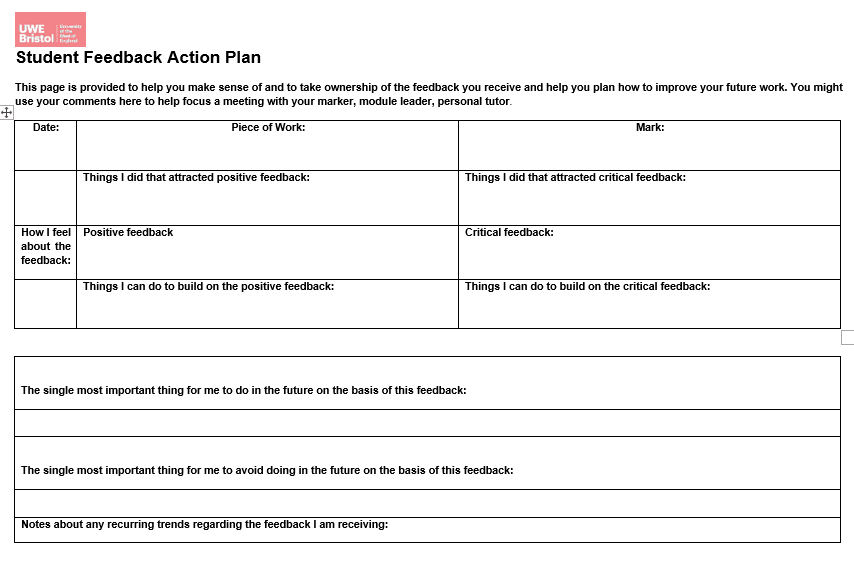
To test that concern, I gathered 158 responses to a survey ‘Student/Apprentice experiences of assessment feedback’ across the Occupational Therapy undergraduate and apprenticeship cohorts. The findings give us valuable insights into what students and apprentices want and appreciate from feedback/feedforward and confirmed our suspicion that the Student Feedback Action Plan, a tool widely used across multiple programmes in UWE Bristol, is not fulfilling its purpose. Many respondents were either unaware of it (it sits on page 4 of the downloadable assessment feedback/feedforward document), despite it being part of the feedback documentation they receive, and over 80% had never used it. This reinforces a wider pattern in which students focus on the mark (top of the form) and engage variably with the feedback comments. As the wider literature suggests, students may access the grade but miss the developmental value of feedback, and our own data echoed this concern, with some students describing feedback as feeling “too long or overwhelming” or like something that has lost significance, belonging only to a past module.
The next phase was to complete focus groups to explore student and apprentice preferences for feedback delivery in more depth, including what helps them notice, interpret and act on feedback, followed by a staff focus group where the key findings from student and apprentice data could be given context and potential suggestions for changes discussed. A key learning early on was that we need to factor in feedback literacy from the very start of the course, rather than assuming students will naturally know how to use feedback/feedforward well.
As a backdrop to this work, we have revalidated the programme, and the rollout of the new curriculum began in September this year. With a wider variety of assessment types being introduced, this creates a timely opportunity to rethink how feedback and feedforward are designed alongside assessments rather than added afterwards. Importantly, any revised process needs to work better not only for students and apprentices, but also for markers and the wider programme team, so that it is realistic, consistent and sustainable in day-to-day practice.
What solutions will you implement?

Rather than introducing large-scale change all at once, we are framing this as a focused trial within the wider programme redesign. The main change will be to dispense with a standalone downloadable feedback document and keep feedback within Blackboard, alongside existing rubrics and annotated scripts. As we adopt a wider variety of assessment types, we are also considering how annotation might be incorporated into wider marking practices, such as for presentation assessments.
- Develop standard operating guidelines for marking and provide team training. One of the key findings about consistency has shown that we first need a shared understanding of the factors that support consistent, useful feedback. This will help us become more feedback literate as a marking team and then model and develop that literacy with our students and apprentices.
- Make feedback comments brief but usable and structured around: ‘What you did well; do more of this next time; even better if…’
- Embed optional, accessible prompts within Blackboard. Rather than enforcing a reflective activity, we will provide a clearly flagged prompt that is quick and easy to complete. It will remain optional because students do not want to feel that they are doing ‘more work on work’ they have already completed.
- Routinely incorporate review of the previous assignment within briefings for the forthcoming assignment. Within this we are exploring the idea of using AI to gather themes from whole cohort feedback and explore these with students and apprentices in their assignment briefing sessions.
The evidence has also helped us decide what not to adopt at this stage. We will not trial alternative delivery modes such as audio feedback, and we will not make a reflective activity compulsory. Instead, future assignment-brief sessions will explicitly refer back to feedback from the previous module, make clear links to relevant practice skills, and help students recognise how strengths and successful approaches can be carried forward into the next module. Together, these changes aim to make feedback clearer, more consistent, more relevant and easier to act on, while remaining manageable for students, markers and the wider programme team.
What challenges did you encounter?
There have been several challenges, some anticipated and some not.
A key concern, as is often the case in academic research, is that the students and apprentices who chose to complete the survey and/or join a focus group are those who are generally more motivated or willing to share their opinions. This has the potential to mean that we are not designing changes to impact positively on all students and apprentices who might require the support to achieve a more productive relationship with feedback/feedforward. Certainly, the student and apprentice focus group was not widely representative of the student and apprentice population demographically so though rich and valuable in its outputs, we have had to acknowledge that there may have been other perspectives we have failed to capture.
The comments about consistency are one of the strongest themes to have emerged. Both students and apprentices describe experiencing differences in how markers explain feedback, in the level of detail provided, and in frustration when comments appear to recur from assessment to assessment rather than be explicitly tailored to their work. They also want much more concrete examples of what they have done wrong and what a stronger piece of work might have looked like.
Interestingly, the option of audio or video feedback was broadly unpopular across cohorts, suggesting that the issue is not simply offering more formats, but improving the usefulness and personal relevance of the feedback itself. Related to this is frustration that when marking grids feel generic and are not clearly mapped to module learning outcomes, this can make feedback feel disconnected from what students were actually being asked to achieve. However, we are transitioning to using marking rubrics more routinely, and this has already been seen to improve satisfaction with links to module learning outcomes (MLOs).
What are the next steps?
The next steps for this case study are to examine where we can add training in feedback literacy to taught sessions so that expectations are aligned between teaching and learning.
We will be trialing one or two specific changes as mentioned in a small number of modules, gathering student and apprentice perspectives on these more systematically through further short surveys, and using light-touch digital indicators (such as feedback access data) to explore patterns of engagement while remaining cautious about overinterpreting them. Alongside this, I will reflect on whether these changes genuinely support students and apprentices to articulate clearer next steps and apply feedback more effectively in subsequent work. This work will also contribute to my ongoing scholarly development, and I plan to revisit and refine the design as I learn more from students, apprentices and colleagues.
What top tips would you offer others?
Based on where I am so far, I would offer the following to colleagues considering similar work:
- Start with the problem as experienced, not the tool. Be clear about what isn’t working before deciding how to fix it.
- Make one small change at a time. It’s much easier to learn from one tweak than from five simultaneous interventions. See part 2 for ideas on small changes.
- Design for what students actually do, not what we hope they’ll do. If an activity is long, optional, and disconnected from future assessments, many students will skip it, and that may be acceptable if we have built-in opportunities for feedback literacy and dialogue about change.
- Treat constraints as design parameters. Workload, timing, and systems are not barriers, they shape what is realistic.
- Share work in progress. Waiting for perfect results means we miss opportunities to learn together.
If you have any additional advice to share regarding giving feedback that sticks please do share it in the comments below.
Thanks for this great article Hazel. It highlights clearly the need for staff and student feedback literacy. One of my favourite ways to improve this has, in the past, been encouraging peer feedback. Once student have marked work they have a much better understanding of what is required, and how they can use feedback.
I love the idea of linking back to the previous assignment as part of the briefings for upcoming assignments. It’s a good way to demonstrate the learning journey to students and hopefully will prompt them to examine the feedback they received more thoroughly.
I think feedback literacy is seen as a skill exclusive to education, when in fact it’s very much a skill required for employment too. The ability to give, receive and utilise feedback is something people are expected to do throughout their career.
Thanks for sharing Hazel – great to hear about this work on feedback literacy and would love to hear how it goes with the next steps. Happy to share work we’ve done in the Library Learning Development team on using examples from student submissions to highlight concrete examples of more/less successful writing. We’ve also got materials on how to use feedback to improve your next assignment that we can share.