

Dr Anne Johnson, Associate Professor for Knowledge Exchange and Public Involvement in Learning and Teaching, College of Health Science and Society (CHSS)
My role focuses on ensuring that the ‘voices’ of public partners are integrated into learning and teaching throughout our students’ time with us at UWE, including the first steps of their journey and the student selection interview processes. The impact of involving the public in our programmes is well recognised and, for many, a statutory requirement for qualification and professional registration. Public involvement can take many forms, including face-to-face input and utilising digital options such as the Shelf Life project recordings.
Prior to embarking on this project, I followed the Digital Skills Programme provided by UWE. To produce the project, I collaborated closely with the CHSS Digital Learning Team on this project, drawing on the expertise of Keith Mitchell, Robyn Weeks, and Caroline Plaice, our College Librarian.
This case study explores how the Public Involvement Team tackled the challenge of a lack of dementia teaching resources available to support the Mental Health Nursing Programme. Anne and Fiona Lewis, PI adviser and administrator and colleagues from the Glenside Library and the Digital Learning Service, established the Shelf Life project – a virtual resource of lived experiences, for academics to use for teaching and learning purposes.
The Problem
In the College of Health Science and Society (CHSS) there has been an appetite to better integrate public involvement into learning and teaching processes. The main driver for this is to enrich students’ educational experiences by incorporating the voices of individuals with lived experiences of relevance to their programmes of study. We also want to ensure that a wide range of voices, including those from underrepresented and diverse communities, are included in the educational offer.
To address this driver, I have created the Public Involvement Database of Public Involvement Partners (PIPs), with the support of Fiona Lewis, PI administrator and adviser. The number of PIPs included on the Database has grown from 30 to 84 over the last three years. This growth, achieved in part through effective outreach work and knowledge exchange, reflects our ongoing efforts to include diverse voices and experiences in public involvement initiatives in learning and teaching.
As part of this work, I conducted a mapping exercise with nursing, midwifery and other programme teams in the School for Health and Social Wellbeing (SHSW). This mapping highlighted a lack of structure, diversity, and consistency in how public involvement was implemented across various programmes. Some of the reasons for this included a general lack of confidence among academics in effectively utilising public involvement resources, which has resulted in a fragmented approach, with some programmes being more proactive than others. Academics have also mentioned the lack of available teaching resources linked to the experiences of people living with a variety of health and care needs. The Mental Health Nursing Team mentioned dementia resources as a possible area for development.
The Solution
This lack of suitable resources gave me the idea for creating Shelf Life. The vision was to produce our own, home-grown library of the lived experiences of local people, to inform future practitioners of the needs of the public they will be supporting once in practice. The Shelf Life project captures public involvement through the creation of a virtual shelf of video case studies which feature individuals with a wide range of lived experiences. The project aims to provide a highly curated set of diverse and impactful learning resources for students.
To start off the process a Public Involvement Partner (PIP) with lived experiences of dementia was contacted about being in a film. The Digital Learning Service helped with the filming process and by collaborating with the Glenside Library and media teams, we have now produced a collection of video case studies. These case studies cover a range of topics:
- Sensory Loss – Personal accounts of coping with sensory loss, highlighting its impact on daily life for individuals and their families.
- Maternity – Insights into maternity care, including critical reflections on adverse events that should not occur in modern healthcare practice.
- Dementia – Lived experiences of individuals and families affected by dementia, including sensitive topics such as end-of-life care.
- Cancer – Accounts of living with and beyond cancer, emphasising the importance of person-centred care.
Working closely with Caroline Plaice, Glenside Librarian, the video case studies have now been collated on the Talis Aspire reading list platform (Shelf Life reading list). Each resource includes a brief description and trigger warnings where applicable. College colleagues can request specific recordings if required, and are encouraged to provide feedback and suggest additional resources. The resource will be continuously updated and expanded based on needs and feedback.
“I will be your strength if you will be my memory”
From the intimate story of Bernadette’s and Howard’s experiences of living with dementia
The Digital Learning perspective – Keith Mitchell
I met with Anne and Fiona in the summer of 2023 to discuss the making of 10, short 5-minute films featuring people with a lived experience. The subjects were wide ranging and included topics such as the care of someone with dementia, the death of a child and breast cancer. In our initial planning meeting we quickly came to the decision to do a series of long-form interviews of up to an hour each, which would then be cut down to a more manageable length.
Prior to filming, Anne and Fiona arranged an in-person introduction with both the participants and members of the Digital Learning Service who would be responsible for filming. The introduction gave participants the opportunity to meet staff involved and discuss any questions or concerns they may have.
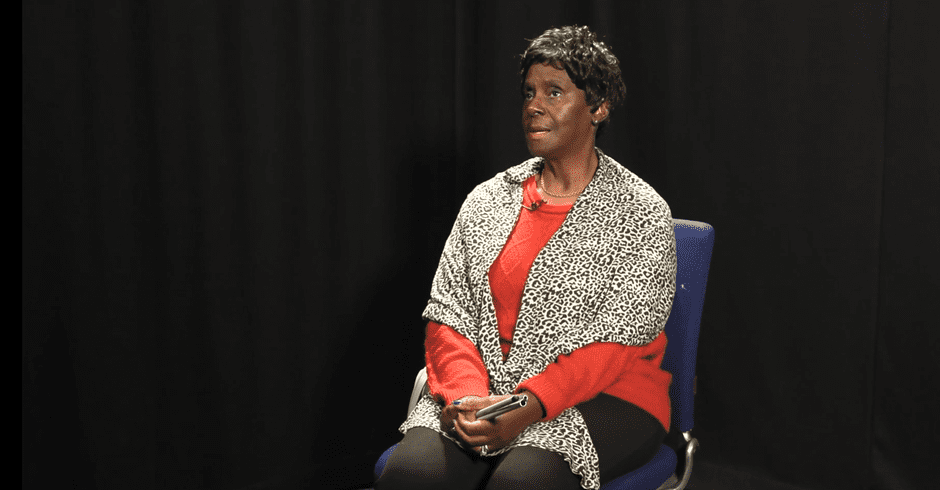
Given the highly sensitive nature of the topics involved, we offered participants the option to have their stories created through a whiteboard animation. A whiteboard animation would enable participants to be anonymous if they wished and had been successfully used in similar projects. All participants who agreed to be a part of Shelf Life decided to be filmed and had no concerns with remaining anonymous, so animations were not used for this project.
The decision was made that it would be easier for the participants to come to us for the recording rather than for us to invade their homes with production gear. One of our subjects had recently moved to Australia and so that interview had to be conducted and recorded via Teams. All of the other interviews were recorded in our small studio at Frenchay using two locked down Canon 4K video cameras with the intention of final delivery in 2K HD. This established method makes it possible to zoom in and reframe a shot in post without losing resolution. It’s very useful when you can’t put an operator on every camera. As an experiment, we also mounted a third camera onto a slider to see if footage with some horizontal movement in it would add a bit of additional interest.
However, with all the cameras focused solely on the subject and not using a 2-shot of interviewer and interviewee, the slider footage did not add anything to the project. In fact, it was a little distracting. Using the slider for a wide 2 person shot in a setting where the background adds to the story may work better for future interviews. The audio was recorded using wireless lavs and an overhead mic. Mixing the two in post can give a more natural room sound. We recorded most of the interviews during the summer when the university was relatively quiet. However, by the time of the last recording noise from outside the room was becoming very intrusive. It’s something we are going to have to address, especially with the sensitive nature of the subject matter.
Editing these kinds of interviews is a long process. It starts with syncing up all the media files and then using Adobe Premiere’s built in AI transcription facility to transcribe the audio to a text file that includes time codes. A first rough off-line edit is then uploaded for review by Fiona and Anne who can then create a new edit decision script from the timecoded transcription file. A second edit is then made, and the review process is repeated. When all the content has finally been agreed with all parties, an online edit is completed which includes adding any graphics, colour grading, audio sweetening and subtitling. The final videos are then uploaded to the Shelf Life Panopto folder. We have made 5 films so far with a sixth in production. It is hoped that we will add further titles to the list of subjects in the near future.
Any challenges
The main challenges faced were around the need to address technical and legal challenges, such as ensuring GDPR compliance, obtaining legal consent for video use, and managing the technical aspects of creating and hosting the videos. A suitable recording venue has also presented challenges as noise has been an issue during some of our recordings at the Frenchay Campus with students and others passing by just outside the current space available. It is hoped that for future filming a quieter room will be accessed to improve the quality of the resources produced.
Below you can see a video of a Good Practice Session in which I outline the project.
Feedback from staff and students
The feedback from staff and students has been overwhelmingly positive. The video case studies have been well-received, with students finding them engaging and impactful. These resources have helped students understand real-world applications and the human side of their studies, making their learning experiences more meaningful.
Next steps
The next steps for the Shelf Life project are focused around ongoing evaluation and expansion. We want to regularly assess the impact of these resources on student learning and make improvements based on the feedback we receive. The Digital Learning Service will be helping us with this work. We also want to develop more video case studies and include new topic areas such as those of Albanian and Somali families living in the region, to better amplify underrepresented voices.
Another important focus will be increasing awareness and usage of the Shelf-Life resources among academics and students. We want the videos to be fully integrated into the curriculum and achieve their maximum impact. I plan to send out a call to academics in CHSS to gather their input on further priorities for developing new Shelf Life films or podcasts. Please do get in touch if you have any suggestions!
Top 5 tips
- Identify what resources you need and want to produce – conduct a mapping and gapping exercise with key people to confirm or modify your hunch
- Make strong links with the CHSS Digital Learning Team – they are a valuable resource and work using a structured project process
- Meet with all parties involved to ensure shared expectations of what will be produced
- Take advice from the UWE legal team if necessary, regarding securing informed consent
- Ensure the environment is conducive to getting the best out of the participants and the successful production of a recording