

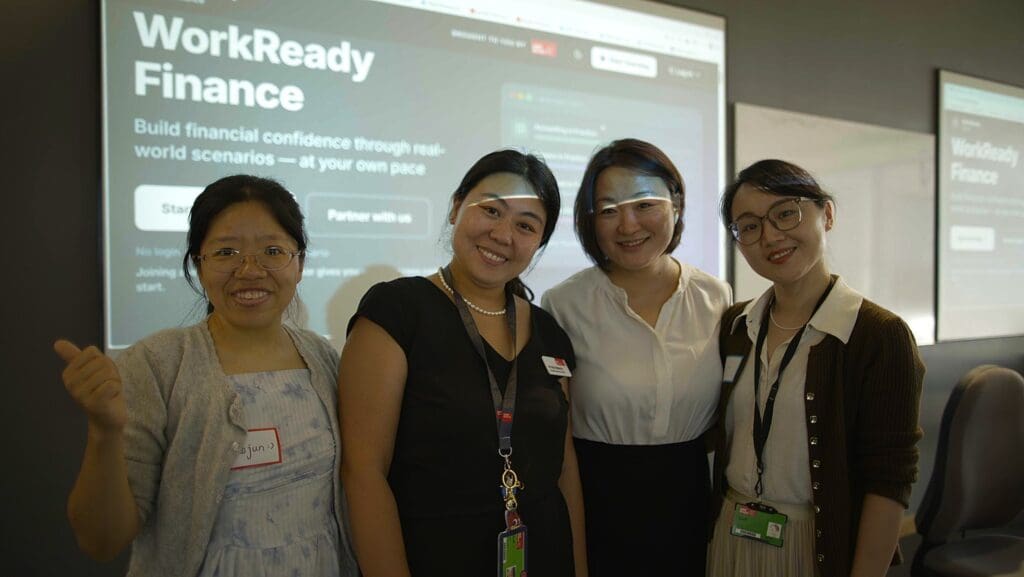
Dr Yan Zeng is a Senior Lecturer in Accounting and Finance and Programme Leader for BA (Hons) Business Management and Economics. Dr Rui Roberts is a Senior Lecturer and Programme Leader in Accounting and Finance. Dr Helen Zhang is a Senior Lecturer and Programme Leader for the Accounting and Finance top-up programmes. Dr Xiaojun Luo is an Associate Professor in Financial Technology.
All four work in Bristol Business School, and each leads one WorkReady Finance module: Finance in Practice (Yan), Accounting in Practice (Rui), Investment in Practice (Helen) and FinTech in Practice (Xiaojun).
In this case study, four Bristol Business School academics share how they used AI to help create WorkReady Finance, a phone-based business game that turns finance concepts into real-world decisions.
WorkReady Finance is a UWE Bristol knowledge exchange project funded by the Higher Education Innovation Fund (HEIF) from March to July 2026.
Our learners were members of the public rather than UWE students, including jobseekers, women returning to work and small business owners. We ran three free pilot workshops on 2, 4 and 10 July 2026, at venues including Frenchay Campus and the Spitfire Hangar in Brabazon.
The problem
Finance shapes almost every working life, yet many people find it hard to learn. The Financial Conduct Authority’s Financial Lives 2024 survey (PDF) found that 22% of UK adults lacked confidence managing their money, and 36% had low knowledge about financial matters.
In our experience, finance can feel:
- abstract: concepts without context
- intimidating: a fear of getting it wrong
- passive: listen, copy, calculate
These barriers hit hardest for people outside formal education, such as jobseekers, women returning to work and people thinking about starting a business. Much of the free support on offer is passive too, built around articles and videos rather than practice.
So we changed the starting point. Instead of beginning with a formula, we wanted learners to begin with a decision a real business owner faces, and to pick up the finance they need along the way.
That created a practical problem for us as academics. Interactive simulations usually need a development team and a budget well beyond a small knowledge exchange grant. We needed a fast way to turn our subject expertise into something people could play, and to test it with real learners within one funding cycle. Generative artificial intelligence (AI) gave us a way in.
The solution
We built WorkReady Finance, a scenario-based game that runs in a web browser on a phone or tablet. Learners step into a realistic business, make the decisions an owner would make, and see how each choice affects cash, debt and ownership. The loop is simple: choose, decide, see the outcome, discuss, reflect and have another go. Low stakes and visible consequences let financial reasoning grow through action, not just explanation.
Our pilots used the Coffee Shop scenario, in which learners:
- pick a town and shop type, using real UK rents and start-up costs
- raise £40,000 from £8,000 of savings, mixing options such as a government-backed Start Up Loan, crowdfunding or a business partner
- fit out the shop while keeping a cash reserve
- survive a setback, such as a quiet launch, as three months of trading play out
- change one decision and run the three months again
There is no single right answer. Feedback explains the trade-offs between debt, ownership and risk rather than marking choices right or wrong.
Where AI helped
- Prototyping: we built our first playable prototype in Google AI Studio, which let us test the idea quickly and show it in our funding bid.
- Specifying the build: we wrote each scenario as a plain-English specification, with every formula and a worked example, so a developer or an AI coding assistant could build from it. Our technology partner, EdTechLab, then built the platform.
- In the app: the Coffee Shop game uses fixed formulas rather than AI, so the same choices always give the same results. An AI coach for the investment module is in development.
Workshop design
Each workshop was a conversation, not just a demo: a partner spotlight, a live play-along, questions and networking. Participants joined by QR code, with no personal details collected, and left with app access and a certificate.
Challenges
- Fast is not the same as good. AI gave us a convincing prototype quickly, but its content was generic. The real work was writing the scenarios, figures and feedback ourselves.
- Checking accuracy. AI tools can be confidently wrong. We wrote out every formula with a worked example to test the build against, and our own testing still caught mismatches between what staff set up and what learners saw.
- Time and scope. Four academics shared the work within one short funding cycle. We built one scenario, the coffee shop, properly from end to end, and plan to reuse its structure for the others.
- Usability. Early versions of the staff dashboard felt too complicated, so we tested each version ourselves and sent detailed feedback to our developer.
- Live delivery. Venue wifi is a risk when a whole room plays at once, so we kept a printed QR code and a pre-loaded game as backups. People also moved at different speeds, so the presenter’s game was projected for everyone to follow. One participant suggested playing each step together as a room.
- Accessibility. We used plain English and a mobile-first design, and learners needed no account. Even so, 15 of 24 respondents found the content easy to understand and one asked for a translation feature, which tells us some learners need more support.
Feedback from staff and students
We received 26 survey responses across the three pilots, and 24 people answered the rating questions:
- all 24 (100%) were satisfied with the workshop
- 20 of 24 (83%) found it very or extremely helpful
- 22 of 23 (96%) would recommend it to others
- 21 of 24 (87.5%) said the hands-on activities or the app were the most useful part
“This will help someone wishing to start a business and give them confidence to ask questions that they are not willing to ask as don’t want to admit they don’t know.”
Workshop participant, 4 July 2026
“This is a startup finance simulation. You run a shop, manage cash flow and learn safe personal investment rules.”
Workshop participant, 10 July 2026
“Excellent App, easy to use”
Workshop participant, 4 July 2026
Quotes are shared anonymously, with consent. Since the pilots, several organisations have asked about running joint workshops with us.
Next steps
The feedback is shaping our roadmap. Budgeting and saving were the most requested topics, and 17 of 22 respondents said they would come to a future session (the rest said maybe). Next, we plan to:
- deepen the Coffee Shop scenario and build out its three-month trading loop
- add the Cleaning Company and Personalised Gifts scenarios
- develop new modules shaped by demand, such as sustainable financial planning
- embed the platform in Bristol Business School teaching, where module leaders can release scenarios as practice or assessed activities without writing code
- run more workshops in Bristol and internationally, including a planned session at Xi’an Jiaotong-Liverpool University
Top tips
- Start with a decision, not a definition. Put learners in a realistic situation and teach just enough finance at the moment they need it.
- Do the design thinking before you prompt. AI tools build faster and better from a clear, plain-English specification, with every formula and a worked example to test against.
- Keep AI out of the numbers. Use AI to prototype and support, but keep calculations and marking predictable, so the same choices always give the same results.
- Build one scenario properly first. One polished journey gives you a template to reuse, which beats several shallow ones.
- Make it low stakes and social. Explain trade-offs instead of marking answers wrong, and let questions, discussion and networking deepen the learning.
Want to try WorkReady Finance with your students or community partners? Visit the WorkReady Finance website or get in touch with any of us.
Resources
- Gamifying Finance Education: Using AI to Create Engaging and Authentic Learning – slides presented at UWE Learning and Teaching day, 2nd September 2026
- Video: WorkReady Finance pilots highlights reel
- WorkReady Finance website